Tampilkan postingan dengan label desert fern. Tampilkan semua postingan

The Desert Fern

Diposting oleh alexandria joseph | 02.00


During my investigation into our fern garden, I discovered this native plant to the Sonoran desert.  I do say it often but this is another favorite shrub/tree of mine.  The leaves on this plant are similiar to those of the Jacaranda or Mesquite trees.  Being native to our area, the care instructions for this tree are quite simple.  Plant it and it will grow.  Water once a week during the hot summer months for quicker growth, but also be careful not to overwater.  The ferny look of this plant is what sold me, but you may also be fascinated to find out that it produces little fuzzy yellowish white balls in spring.  During our winter freeze, the tree lost a lot of its' leaves, but it has since rebounded back in spring when temps warmed up.  For an additional punch to a part of the garden, I put the Mexican Bird of Paradise and the Desert Fern together and it makes an incredible statement.  You can see a part of this plant in the headlining pic of this blog.  Where is it?
Where is it?  I'll give you a hint.....to the left side.

At first this tree, may grow slowly, but as it gets older it will gain height faster.  Therefore I am going to say that the Desert Fern grows moderately for me.  This is a definite must for your landscape. Low maintenance and native!  Some people will sometimes mistake it for a Mesquite because of the ferny foliage.  I think it looks rather different, but everyone has their own thoughts. In my opinion, there are two stunning trees for the Tucson area....the Texas Ebony and this Lysiloma.  Many people like to put this tree in a corner near a wall.  It has grown for me 8 feet but it will certainly get taller and wider over the years.  It likes sun with some regular water.  During a good monsoon, you won't have to water this tree, but in June it should get a weekly water. The following information below will tell us why the Mesquite and Lysiloma are similiar in appearance as well as many other plants in our Sonoran landscape.  Here's a little background......
Picture taken by Mark A. Dimmitt
The following information is from one of my favorite places to visit....the Arizona Desert Museum. Here is some information from their website about the wide varieties of plants that succeed in our desert....known as the Legume Family or Fabaceae.

The Legume Family
"Legumes are a very large family of 16,000 species in nearly all of the world's habitats. Champion drought tolerators, they are most abundant in the arid tropics. Their prevalence in the Sonoran Desert flora (for example, there are 53 legume species in the Tucson Mountains, 8% of its plants) reflects this desert's tropical origin. North of the Mexican border most of the common Sonoran Desert trees are legumes.


Description

The family was named Leguminosae for its fruit, which in most species is a legume (the technical term for bean pod, a single-chambered capsule enclosing what appears to be a single row of seeds that is actually two rows — alternate seeds are attached to opposite halves of the pod). There are three subfamilies with flowers that look very different from one another at first glance, but arose from a common pattern: Caesalpinioideae, Faboideae, and Mimosoideae

Mimosoideae subfamily

The petals are fused in this group, but they're so tiny that they are not noticeable. What one sees is a powder puff of stamens. It's easy to visualize the derivation of flowers of this group from the above subfamily. Start with a caesalpinoid flower such as a Palo Verde blossom. Reduce the petals until they nearly disappear, greatly elongate the filaments of the stamens, and combine several to many flowers into a tight cluster. The visual result is a ball or cylinder of stamens (powder-puffs or catkins, respectively). All species are woody. Examples include acacias (Acacia), mesquite (Prosopis), fairy duster (Calliandra), and mimosa (Albizia).

Notes

Plants require large quantities of three minerals: nitrogen, phosphorus, and potassium. The latter two elements are present in soil, but nitrogen is an atmospheric gas that plants cannot use directly. Some soil bacteria and cyanobacteria (blue-green algae) can fix nitrogen (convert it into nitrate or other compound) into a form which plants can use. Another major source of nitrogen is the decomposition of dead plants and animals. In arid soils especially, where decomposition of organic material is slow, plant growth is often limited by the available amount of soil nitrogen. Many legumes harbor colonies of nitrogen-fixing bacteria in their roots. The plant provides favorable habitat and carbon for the bacteria, and the bacteria in turn provide surplus nitrate to the plants. Nitrogen-fixing legumes have higher concentrations of nitrogen compounds in their tissues than non-fixing plants. When legume leaves decompose they release the nitrogen and enrich the soil. Nitrogen is an essential element in proteins, so nitrogen-fixing plants can make large crops of seeds with high protein contents (more than 50 percent in some species).
The typically large, nutritious, and abundant seeds of legumes are an important food source for many wildlife species, including insects such as bruchid beetles. Adult bruchids are flower beetles, while the larvae of most species are seed predators. Bruchids are not restricted to legumes, but there is a myriad of species that specialize on legume seeds. Some species are very host-specific, while others feed on a wide range of seeds. Decades of intensive study of the bruchid-seed relationship would likely not reveal all aspects of this tiny part of the ecological web." End of article. Written by Mark Dimmit. Mark A. Dimmitt,
A Natural History of the Sonoran Desert (ASDM Press, 2000)
Source: http://www.desertmuseumdigitallibrary.org/public/detail.php?id=ASDM21774&sp=Lysiloma watsonii


Labels: , , , , , , , , ,


The Canopy Connection

Diposting oleh alexandria joseph | 11.22


Happy New Year!!! As promised, I would get this writing finished before I begin teaching again.  It has been a wonderful time for me as I have been writing, volunteering, reading, and just thinking.  I've set my gardening projects up for the spring, and I can't wait to add more plants.  What will it all look like when finished?  The past week I made the purchase of 10 whiskey barrels that will contain the cactus garden for the property.  I have the cacti ready to plant which include agaves, prickly pear(the purple variety:), totem poles, and the list goes on and on. There is so much more to work on in the gardens in 2011.  However, I won't be posting as much in the following weeks with school starting up again. 

A typical Amazon morning in the forest....the mist reveals the various heights of trees.

Here is my own work below from the Amazon in 2008
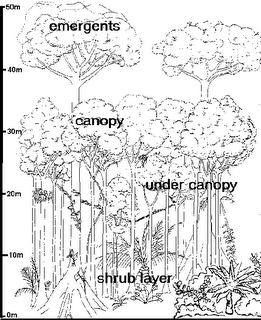
Today's write is about the canopy we create above our heads in the garden/s. For many people, myself included, when we moved into our home, there were trees established on our property. Or for some, there was nothing.  I have a lot of space to work with here on the grounds and each space is considered its' own garden.  One of the spaces is named the fern garden because all the plants have fernlike leaves and when the sun hits the leaves, it filters to the ground nicely. Very few ferns can grow in our desert  and unfortuneatly, it's one of the plants that I don't try and grow anymore. I have luck with the asparagus fern and that does really well in Tucson(so some varieties are out there for the fern fan club just not the ones many people like:)  You need moisture in the air and that is something we don't have an abundance of.....so you have to think about things you like about the fern and find plants that have similiar qualities.  You can then  recreate that look about ferns in your own garden space. 
Let's get back to the canopy. A garden is not what we only create below us on the ground but one that we can also create in the sky above.  It's probably the trickiest art form of them all.  The inspiration that I have used in my own work is from the forests both here and abroad.  A homeowner must always use caution when planting trees closer together and near homes for a variety of reasons such as the roots damaging pipes, the foundation and/or the structure itself.  Again, precautions must be taken to prevent trees limbs from falling off and smashing onto the roof or side of the house.  I speak from experience on this latter issue.  Mesquites are fantastic trees but they can also be dangerous during a wind storm.  Branches, sometimes large ones, like to fall off and smash everything in its' path.  The key to this is pruning....not liontailing as I have written about before, but the sometimes necessary removal of a tree limb to prevent harm or damage to structures and/or people.  These are the technical aspects of creating the canopy....now let's look into the art of the canopy.

Once the homeowner has established what's acceptable to place in the space, s/he can begin to design the air space above.  My particular fern garden will allow for light and wind to filter through like a southern garden that has willows.  Standing in the rain forest, looking above, you see birds and monkeys and a million other things living amongst the tree tops.  While this is the desert, it doesn't mean that life doesn't exist....quite the opposite!  We have so many birds here(see my previous post on Christmas in the Canyon).  I had to look at tree shapes and at their maximum mature heights to see how they would all interlock together.  Some trees are tall and narrow while others are rounder and shorter. Then you sketch on a sheet of paper the projected image of how the sky garden will look.  Don't be discouraged if the growth doesn't happen overnight. And you may have setbacks!  Remember my Chinese elm that croaked due to Texas Root Rot?  I researched and found a resistant Texas Ebony to replace the tree.  While slower growing, it will eventually connect with the other trees.  Some trees will shoot high into the sky and be narrow while others will create the "lower-to-the-ground" look and the mid level trees will fill out the center layer of sky space.  When put together, it will be the equivalent of a desert-like amazon rain forest....except all xeric:)  For this particular garden, I used a mesquite, the desert fern tree(lysiloma), the chitalpa, the jacaranda, the eucalyptus tree, the Texas ebony, and finally the Arizona Ash.  That's a lot of tree so figure out who your shorter trees are, then your middle layer trees and finish with your emergents or taller trees.  And like a puzzle, they will all connect in time:)

In the desert, naturally, things are spread out because that's how it works here......however, there are also oasis islands where a person will find these drawings a reality.  Again, observe other places and plan plan plan.  Another garden that I am working on is the tropical fruit garden which is opposite the fern garden.  It will have a different feel but one that will utilize the same ideas with fruit trees that do well here in Tucson like the fig, guava, loquat, etc. This blog is a record of all the things that inspire and create El Presidio Gardens.  A person can't say that just one thing creates a garden because there is so much history, art, observation, technical information......and just knowledge that goes into planning something special like this space.  These pics were pulled from the internet to demonstrate what I am writing about......but you can see in the video from yesterday,  the idea that I am working on from the post called "A Cold End".  Most of the trees have lost their leaves for the winter but you'll definitely see the eucalyptus. I look forward to the new year with the new projects...stay tuned for more in January. There's always something going wherever you may be.  If you're in the North, you're planning and looking through gardening books and if you're in the warmer areas, your protecting plants from frost and beginning your projects before the intense heat.  Wherever you may be....Happy Gardening in 2011!!


Labels: , , , , , , , , , ,


More pics....

Diposting oleh alexandria joseph | 19.10


Labels: , , , , , , , , ,